
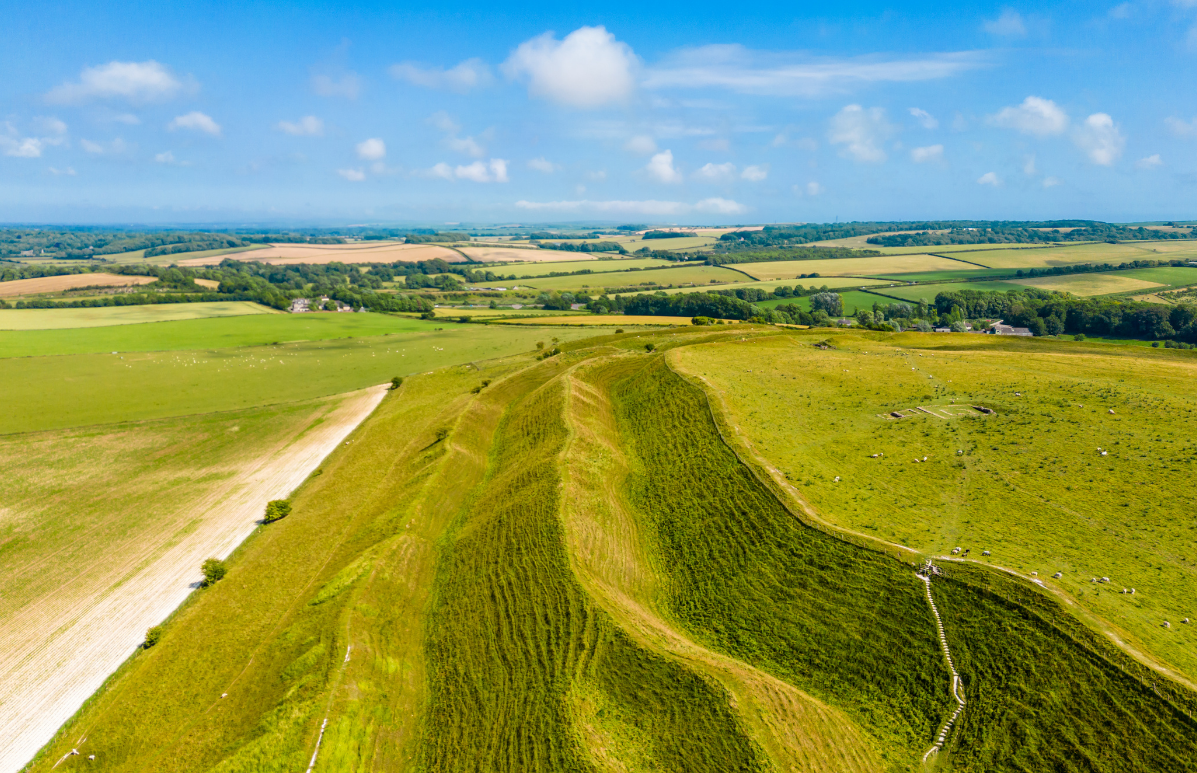
Ancient history in West Dorset
Hill forts, burial mounds and 5,000 years of stories
On a clear October morning, Pilsdon Pen offers a remarkable introduction to West Dorset’s ancient past. For five thousand years, this hilltop has been shaped by human activity.
From the summit, views extend from the Jurassic Coast in the south to the hills of Somerset in the north. The Vale of Marshwood spreads out below. Ancient lanes and hedgerows cross the surrounding countryside, following routes shaped over centuries. Beneath your feet lie two Bronze Age burial mounds and the remains of fourteen Iron Age roundhouses. These traces reveal why this hilltop was once chosen for settlement.
The setting is extraordinary.
West Dorset is rich in ancient history. Within a thirty-minute drive of Blackbird Cottage, remarkable prehistoric and Iron Age sites can be explored. This guide introduces five fascinating places where the past can still be experienced firsthand.
Pilsdon Pen — four and a half miles from Blackbird Cottage
Pilsdon Pen rises to 277 metres at the northern end of the Marshwood Vale, approximately 4.5 miles west of Beaminster.
For many years, it was believed to be Dorset’s highest point. That distinction was eventually awarded to nearby Lewesdon Hill, which stands just two metres higher. The original mistake is easily understood. From the summit, the surrounding landscape appears to stretch endlessly in every direction.
A long history is recorded at Pilsdon Pen. Two Bronze Age burial mounds and the remains of roundhouses and pillow mounds have been identified. The hillfort covers approximately seven and three-quarter acres. Its irregular oval enclosure is protected by two lines of ramparts and ditches. Near the centre, the remains of fourteen roundhouses were discovered.
The hillfort is thought to have been abandoned after the Roman conquest. Like many other Dorset hillforts, it may have lost its strategic importance once Roman control had been established. Today, the original ramparts can still be explored. Wide views and fresh winds provide a vivid impression of the landscape that once surrounded its Iron Age inhabitants.
A connection with the Romantic poets is also preserved here. During the late 1790s, Dorothy and William Wordsworth lived at Racedown House, west of Pilsdon Pen. The surrounding landscape is believed to have influenced their writing, and the hill appears in several of their works.
Getting there: Park at the small National Trust car park on the B3164, between Broadwindsor and Birdsmoor Gate. A short but steep walk leads to the summit. Dogs are welcome on leads.
Eggardon Hill — fifteen minutes from Blackbird Cottage
If Pilsdon Pen is known for its dramatic setting, Eggardon Hill is remembered for its atmosphere.
At 252 metres above sea level, this Iron Age hillfort commands extensive views across the Marshwood Vale and the English Channel. Its elevated position makes it a prominent feature of the surrounding countryside. On clear days, the coastline and distant Devon hills can be seen.
The hillfort is approximately 2,500 years old. Two Bronze Age burial mounds are also associated with the site. During the eighteenth century, Eggardon Hill acquired another historical connection through smuggling. Trees were planted by Isaac Gulliver, a celebrated West Country smuggler, to provide a landmark for his coastal operations. These trees can still be seen today.
Despite its imposing earthworks, Eggardon Hill has never been excavated. Consequently, much remains unknown about the fort’s original layout and purpose. Its ramparts have survived, while the surrounding landscape has retained much of its quiet character. A visit on a weekday morning can be especially peaceful.
Getting there: Follow the A35 towards Bridport, then turn north towards Powerstock. The lane leading to Eggardon is narrow, so care should be taken when parking. The hillfort can be reached on foot from the road.
Lambert's Castle and Coney's Castle — twenty minutes from Blackbird Cottage
No exploration of ancient Dorset would be complete without a visit to Maiden Castle, near Dorchester. Its enormous earthworks provide a striking reminder of the scale of prehistoric construction.
Often described as one of Europe’s largest Iron Age hillforts, Maiden Castle covers an area comparable to around fifty football pitches. Its earliest phase dates to approximately 600 BC. Initially, the site was relatively simple, covering around 6.4 hectares. Over time, its defences were strengthened through the addition of further ramparts.
The surviving earthworks extend across approximately 47 acres. In places, the outer ramparts rise six metres above the ditches below. These formidable structures were created through extensive manual labour, using tools made from materials such as wood, bone and antler. Despite the passage of more than two thousand years, much of this remarkable construction remains visible.
Maiden Castle was eventually captured by Roman forces during the conquest of Britain in AD 43. Its role as a military stronghold subsequently declined, marking a major transition in the history of the site.
Further discoveries can be explored at Dorset Museum in Dorchester, around twenty minutes from Blackbird Cottage. Among the finds associated with excavations at Maiden Castle is the famous skeleton with a Roman ballista bolt embedded in its spine. A museum visit can provide valuable context before or after a walk around the hillfort.
Getting there: Follow the signs from the A354, south of Dorchester. The postcode is DT2 9PP. Free parking is available, and entry is free for English Heritage members. Dogs are welcome on leads.
Maiden Castle — thirty-five minutes from Blackbird Cottage
No guide to ancient West Dorset is complete without Maiden Castle and no visit to Maiden Castle is ever quite what you expect.
Maiden Castle, located near Dorchester, is one of Europe’s largest Iron Age hillforts. Its size is comparable to 50 football pitches.
Maiden Castle itself was built in about 600 BC; the early phase was a simple and unremarkable site, similar to many other hill forts in Britain and covering 6.4 ha. At the same time, Maiden Castle’s defences were made more complex with the addition of further ramparts.
Covering an area of approximately 47 acres, Maiden Castle’s intricate earthworks and ramparts offer evidence of its significance as a fortified settlement and strategic stronghold during the Iron Age.
Walking around the outer ramparts, which in places rise six metres above the ditch below, it is almost impossible to comprehend that these were built entirely by hand, using tools made of bone and antler and wood. And yet here they are, two thousand years later, entirely intact.
Maiden Castle ultimately fell to Roman forces during the conquest of Britain in AD 43, marking the end of its significance as a military stronghold.
The Dorset Museum in Dorchester — twenty minutes from the cottage — holds many of the extraordinary finds from excavations at Maiden Castle, including the famous skeleton with a Roman ballista bolt still embedded in its spine. Worth visiting before or after your trip to the site itself.
Getting there: follow signs from the A354 south of Dorchester. Postcode DT2 9PP. Free parking. English Heritage — free entry for members. Dogs welcome on leads.
Hambledon Hill — forty minutes from Blackbird Cottage
North of Blandford Forum, Hambledon Hill offers an insight into an even earlier period of Dorset’s history.
Neolithic enclosures dating to around 3600 BC have been identified here, long before the Iron Age hillfort was constructed. The hill was therefore used by communities more than five and a half thousand years ago. Their activities predated the arrival of the warriors and settlers associated with later hillforts.
From the summit, extensive views can be enjoyed across the Blackmore Vale and the surrounding Dorset countryside. The landscape is especially striking in clear weather, when the patchwork of fields and distant hills becomes visible.
Hambledon Hill is managed by the National Trust. A walk through the traditional grazing land leads towards the summit, where traces of prehistoric activity can be appreciated alongside the natural landscape. Its combination of archaeological importance and open countryside makes it a rewarding destination for walkers.
A note on what you are looking at
When these hillforts are explored, their ramparts, ditches and panoramic views are often the first features to attract attention. Yet these places were also associated with everyday life.
Evidence of roundhouses, field systems and farmsteads has been identified through aerial photography and LiDAR surveys. At sites including Eggardon Hill, Badbury Rings, Hod Hill and Park Hill Camp, traces of ancient agricultural landscapes have been revealed. These discoveries show how extensively the countryside was cultivated around two thousand years ago.
The people who lived at Pilsdon Pen, Eggardon Hill and Maiden Castle were farmers as well as defenders. Crops were grown in the surrounding fields, while cattle and sheep were kept on the downs. Goods were traded with neighbouring communities, and burial rituals were carried out with care.
Many features of the modern landscape have much older origins. Lanes, hedgerows, field boundaries and valley paths follow routes that may have been shaped over centuries of human activity. Although the countryside has changed, evidence of its long history can still be found throughout West Dorset.
A visit to these ancient sites offers more than a glimpse of archaeological remains. The landscape itself provides a connection with the people who lived, worked and travelled here thousands of years ago.
Quick reference — ancient history sites near Blackbird Cottage
- Pilsdon Pen — 4.5 miles away. Iron Age hillfort and Bronze Age burial mounds. Free access. Dogs welcome.
- Eggardon Hill — Approximately 15 minutes away. Iron Age hillfort with coastal views. Free access. Dogs welcome.
- Lambert’s Castle and Coney’s Castle — Approximately 20 minutes away. Iron Age hillforts managed by the National Trust.
- Maiden Castle — Approximately 35 minutes away. One of Europe’s largest Iron Age hillforts. Free entry for English Heritage members. Dogs welcome on leads.
- Hambledon Hill — Approximately 40 minutes away. Neolithic enclosures and an Iron Age hillfort. Managed by the National Trust.